
Beyond the Tool: Why Your AI Video Workflow Matters More Than the Software
In today’s rapidly evolving digital landscape, it feels like a new “groundbreaking” AI video platform launches every week. From the high-fidelity capabilities of Google Veo to the massive asset libraries of Envato and the hundreds of emerging generative engines, the market is saturated with options.
But here is the industry secret for 2026: The tool is not the strategy. At PRP Studios, we’ve seen that the most sophisticated software in the world won’t save a video with a broken workflow. To move from “AI-generated” to “AI-mastered,” brands must focus on the process rather than the platform.
1. The Pre-Visualization Architecture
A common mistake is jumping straight into a video generator. Professional AI video starts with AI-assisted storyboarding. By using platforms to map out camera angles, lighting cues, and pacing before a single pixel is rendered, you ensure the video serves a business goal rather than just being a visual experiment.
2. The Science of Character Continuity
One of the biggest challenges in the current market is “character drift” – where a subject’s features change between shots. While there are plenty of tools to choose from, the workflow remains the same: you must establish a Digital Character Seed. By generating consistent reference images (front, profile, and three-quarters view) first, you create a visual anchor that allows you to move between different AI engines while keeping your brand ambassador recognizable and consistent.
3. The “Keyframe” Technique (First and Last Frame)
Most high-end generative platforms now offer an “Image-to-Video” (I2V) feature. Instead of relying on unpredictable text prompts, the professional workflow involves generating a hyper-realistic Start Frame and End Frame.
- The Benefit: By providing the “First and Last” images, you dictate the composition and the physics.
- The Result: The AI is forced to calculate the motion between your specific visual markers, eliminating the “hallucinations” that often plague AI video.
4. Directing the “Physics Engine”
We treat the current sea of platforms—from the heavy hitters like Google Veo to niche creative tools—as a toolkit. Some engines are better at fluid dynamics (water and fire), while others excel at human micro-expressions. The expertise at PRP Studios lies in knowing which “physics engine” to apply to which scene to ensure the most realistic outcome.
5. The “Human-in-the-Loop” Quality Gate
No matter how advanced the AI, the final 10-20% of any production must be human. This involves professional sound design, color grading, and “The Edit.” AI produces clips; humans produce stories. The final step of the workflow is where the “uncanny valley” is bridged, ensuring the video resonates emotionally with a human audience.
The Professional AI Production Pipeline
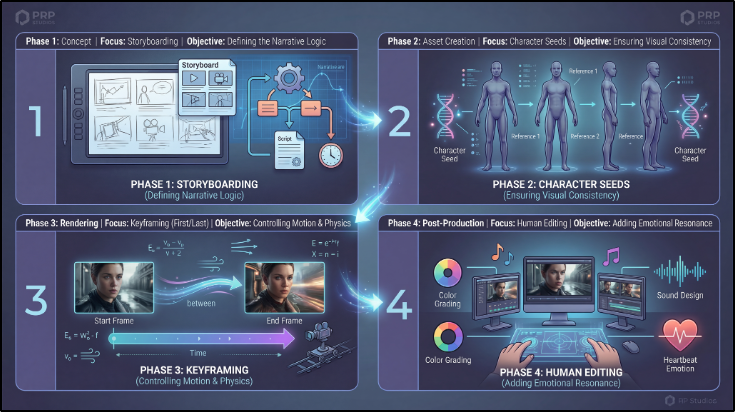
| Phase | Focus | Objective |
| Concept | Storyboarding | Defining the Narrative Logic |
| Asset Creation | Character Seeds | Ensuring Visual Consistency |
| Rendering | Keyframing (First/Last) | Controlling Motion & Physics |
| Post-Production | Human Editing | Adding Emotional Resonance |
FAQs: AI Video Production – Business Perspective (PRP Studios)
1. How does AI video production benefit businesses?
AI video production reduces cost, speeds up turnaround time, and enables scalable content creation while maintaining quality and consistency.
2. How can PRP Studios help businesses with AI video production?
PRP Studios offers a structured, hybrid workflow combining AI efficiency with human storytelling to deliver brand-focused, high-impact video content.
3. Is AI video production cost-effective for brands?
Yes, it significantly lowers production costs by reducing the need for physical shoots, locations, and large crews.
4. Can AI videos maintain brand identity and consistency?
Yes, with proper workflows like character consistency and controlled storytelling, brands can maintain a strong and uniform identity.
5. How does AI video production improve marketing ROI?
By enabling faster content creation, multi-format outputs, and personalisation, AI helps brands reach wider audiences and improve engagement.
6. Can AI video production scale for large campaigns?
Yes, businesses can produce multiple versions of videos (languages, formats, and audiences) quickly, making it ideal for large-scale campaigns.
7. How does PRP Studios ensure quality in AI-generated videos?
Through a “human-in-the-loop” approach, including editing, sound design, and quality checks to ensure professional output.
8. What industries can leverage AI video production effectively?
Corporate communication, government campaigns, education, healthcare, and real estate sectors benefit significantly.
9. What are the risks of relying only on AI tools without strategy?
It can lead to inconsistent branding, generic content, and poor audience engagement, reducing overall effectiveness.
10. What makes PRP Studios different in AI video production?
PRP Studios focuses on strategy-first execution, combining AI technology with communication expertise from PR Professionals.


