
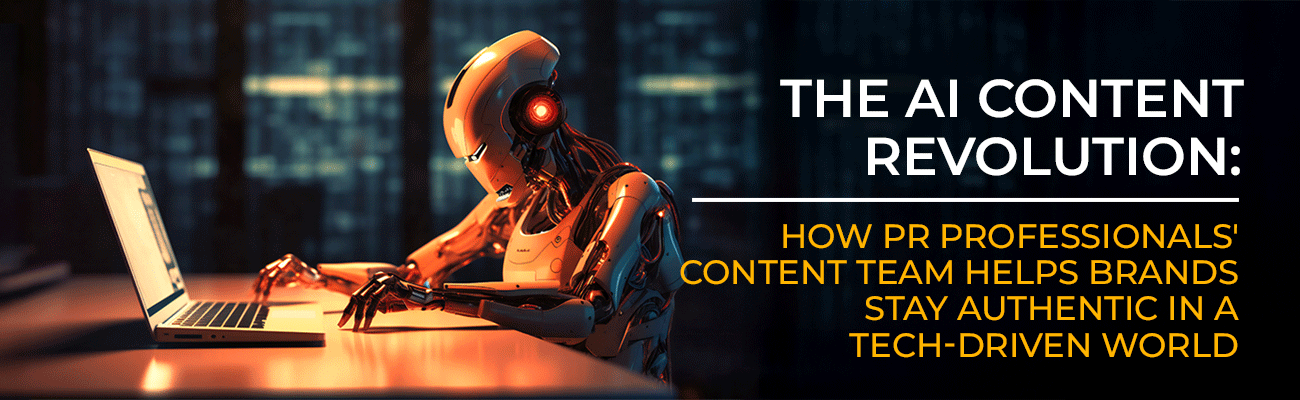
The AI Content Revolution: How PR Professionals’ Content Team Helps Brands Stay Authentic in a Tech-Driven World
PR Professionals (PRP) is the fastest-growing PR Agency in the country
The AI content revolution is not something that is “coming.” It is already inside most marketing teams. Drafts are being generated in seconds. Social media calendars are being filled faster than ever. Campaign ideas are being expanded by tools that did not exist in practical form even three years ago.
Across industries, artificial intelligence has moved from experimentation to everyday utility. Recent industry research confirms that AI is now integrated into mainstream marketing workflows, especially across content creation and optimisation. What started as curiosity has quietly become infrastructure.
And yet, something else has happened at the same time.
As the volume of content increases, sameness increases with it.
When Scale Starts to Sound the Same
Feeds feel repetitive. Blog structures mirror one another. Tone becomes oddly neutral, as though every brand is speaking through the same invisible template.
AI is very good at predicting language patterns. It is not good at holding a point of view. It can summarise trends, but it cannot feel the weight of a regulatory shift. It can assemble a thought leadership outline, but it cannot truly reflect the tension behind a difficult boardroom decision.
Authenticity rarely disappears dramatically. It erodes gradually when communication becomes too clean, too symmetrical, and too cautious.
Research from Adobe’s 2026 Digital Trends report shows that customers value personalised and relevant experiences, yet they still expect brands to remain consistent and trustworthy when using AI. People may not always know whether content was AI-assisted, but they know when something feels hollow.
Adoption Is Not the Problem. Control Is.
The debate is not about whether organisations should use, it is about the way in which it should be put to use. McKinsey’s latest global AI survey confirms that organisations have embedded generative AI into core workflows, particularly in customer-facing functions. The pressure to adopt is commercial and competitive.
The real question is who defines the narrative before the tool generates the draft.
Who decides what should not be said?
Who ensures that a founder’s voice still sounds like the founder?
Technology can accelerate production. It cannot determine positioning. When tools lead before strategy, messaging drifts.
Where Human Judgement Becomes Non-Negotiable
At PR Professionals, AI is treated as an assistant, not an author. It can help structure thinking or synthesise research, but it does not define the story. Every piece of communication begins with clarity about audience, intent, and consequence.
Different stakeholders interpret the same announcement in very different ways. Investors look for signals of stability and direction. Customers look for reassurance and usability. Employees look for alignment and transparency. Media professionals look for clarity and quotable precision.
A tool can generate multiple versions in minutes. It cannot assess which nuance is reputationally sensitive.
Human oversight also protects credibility in a volatile information environment. Global risk assessments continue to rank misinformation among significant threats to public trust. In that context, every assertion must be grounded and deliberate. Automation speeds up drafting. Verification protects reputation.
Authentic Brands Do Not Sound Average
There is another, quieter risk in over-automation. AI models are trained to predict what is statistically likely to sound correct. That often produces language that is safe, balanced, and widely acceptable.
But influential brands are rarely built on average language.
They are built on specificity.
They refer to real trade-offs, not abstract principles. They explain why a decision was difficult. They challenge assumptions when necessary. They show their thinking rather than hiding behind polished neutrality.
AI can help refine that expression. It cannot originate conviction.
The Competitive Advantage in 2026
The brands that will stand out in the coming years are not the ones publishing the most content. They are the ones that remain recognisable while using the same tools everyone else has access to.
Technology is not the threat. Indistinguishable messaging is.
The AI content revolution is revamping the communication production mechanism, but it does not change the reason that it matters. Trust is not developed in silos. Even the most Lucid and consistent work fail to build trust if not ascribed to real people.
At PR Professionals, the mandate is straightforward. Use AI where it adds value. Intervene where judgement is required. Protect tone, context, and credibility at every stage.
Because in a world where machines can generate endless sentences, authenticity is what makes people read them.